Blog/Operations
How to sync Airbnb, Booking.com and Vrbo calendars
 Julie Blanc · Updated November 14, 2026 · 8 min read

On this page+
Short answer
To sync Airbnb, Booking.com and Vrbo calendars, you either connect them to each other with iCal links (free, built into every platform) or put a channel manager in the middle that talks to each platform through its API. iCal works for most small portfolios, but it's polled every few hours, so it can never fully rule out a double booking. The fix isn't only a faster sync. You also need a way to see a clash the moment one arrives.
Here's how each method works, where each one breaks, and how to set up a calendar you can actually trust.
The two ways calendars sync
Every booking platform keeps its own calendar for your listing. Syncing means getting each one to block dates that were booked somewhere else.
| iCal links | API (channel manager) | |
|---|---|---|
| How it works | Each platform publishes a calendar file; the others download it on a schedule | The channel manager pushes and pulls changes directly through each platform's connection |
| Speed | Minutes to hours, set by whoever is reading the link | Usually near real time |
| What it carries | Booked and blocked dates only | Dates, rates, restrictions, often guest details and messages |
| Cost | Free | A monthly subscription, usually per listing |
| Setup | Copy and paste links | Connect accounts, map listings, migrate rates |
Neither one is "the right answer". They solve different problems, and plenty of managers use both: a channel manager for the big platforms, and iCal for everything else.
How to sync Airbnb, Booking.com and Vrbo with iCal
The setup takes ten minutes per listing.
- In Airbnb, open the listing's calendar availability settings and find Connect calendars. Copy the export link.
- Paste that link into Booking.com (Rates & Availability → Sync calendars) and Vrbo (Calendar → Import/export).
- Copy Booking.com's and Vrbo's export links and import each of them back into Airbnb.
- Repeat for every pair. With three platforms, each one has to import the other two.
The fourth step is where most setups go wrong. With three platforms that's six links per property, and it's easy to miss one. With ten properties it's sixty links, and nobody remembers which ones were checked.
A tidier pattern is a hub: every platform imports one calendar, and that calendar imports all of them. The hub can be your PMS, your channel manager or an operations tool. You get one place to look and fewer links to maintain.
Why iCal still lets double bookings through
iCal isn't broken. It's just slow by design.
An iCal link is a file. Nothing tells the other platforms that it changed; each one comes back on its own timetable to check. Airbnb says it refreshes connected calendars about every three hours, and you can press Refresh to check sooner. Booking.com and Vrbo don't publish a fixed interval. The figures quoted around the industry range from under an hour to six hours, and they stretch at busy times.
So picture a Saturday in July. A guest books your villa on Booking.com at 10:05. Airbnb last read Booking.com's calendar at 10:00 and won't look again until about 13:00. For those three hours the same week is still open on Airbnb. Most of the time nobody books it. The one time somebody does, you're refunding a family that has already bought flights.
Three things make it worse:
- Last-minute stays. Short-notice bookings land in exactly the window iCal can't cover.
- Manual blocks. An owner's week typed into one calendar has to travel through every link like any other booking.
- Broken links nobody notices. If a platform regenerates a link or a listing is relisted, the import quietly stops. The calendar still looks fine; it just isn't updating.
Is a channel manager more reliable?
Mostly, yes, for the platforms it connects to. Channel managers such as Guesty, Hostaway and Lodgify connect to Airbnb, Booking.com and Vrbo through those platforms' own APIs. A booking on one platform is pushed out to the others in seconds or minutes, not hours, and rates and minimum stays travel with it.
That's the honest answer to the question we see searched often, "is Guesty reliable for integrating availability calendars across booking sites?" The API connection is far faster than iCal. But two caveats apply to every channel manager, not just one:
- Anything still on iCal stays at iCal speed. Smaller sites, direct-booking widgets and owners' Google calendars usually connect by link, not API.
- Connections fail too. An expired token or an unmapped listing stops updates as silently as a dead iCal link does.
A channel manager narrows the gap. It doesn't remove the need to check.
The part most guides skip: seeing the clash
Most advice ends at "sync your calendars". The better question is what happens when a clash gets through anyway.
In a lot of tools the answer is nothing visible. The import keeps one booking, drops or overwrites the other, and you find out when a guest emails. What you want is the opposite: the overlap is held and shown, with both bookings named, so a person decides what happens next.
Whatever you use, check these:
- Does an overlapping import show up as a conflict, or does it silently replace something?
- Does each calendar feed show when it last synced and whether it failed?
- Can you trigger a sync by hand before confirming a last-minute request?
- Are your exports private? Outgoing feeds should say "Booked", not your guests' names.
Here's what the first check looks like when a tool gets it right — in this case Recal, which we make:
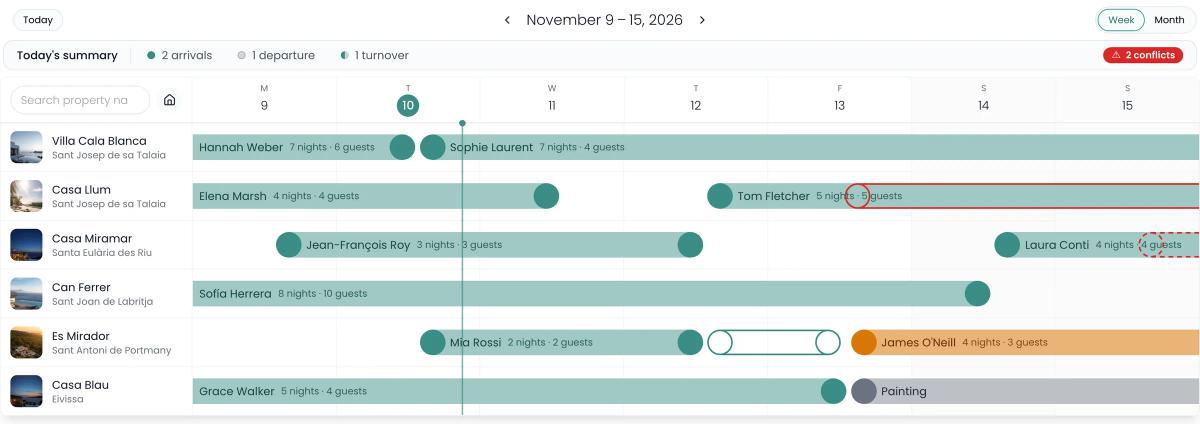
Both bookings stay visible, the clash is outlined in red, and someone decides what happens next. More on how Recal handles calendars.
Setting it up for a multi-property portfolio
Once you manage more than a handful of homes, organise sync around one calendar rather than a web of links:
- One source of truth. Every platform imports one calendar per property, and that calendar imports every platform. A property tool can be that hub, so the whole team works from the same calendar.
- One rule for owner stays. Owner weeks go into the hub, never directly into a platform.
- A weekly feed check. Look at last-sync times for every feed, and fix any that have gone quiet.
- A clash habit. Before confirming any booking inside 72 hours, refresh and look for conflicts.
We go deeper into running one calendar across a portfolio in One calendar, every property, and into what channel managers do and don't cover in What channel managers don't do.
Sources: Airbnb Help Center, "Sync your Airbnb calendar with other calendars"; Booking.com and Vrbo partner help pages on calendar import and export (accessed November 2026). Refresh intervals are set by each platform and change over time.
Questions
How do I sync my Airbnb calendar with Booking.com and Vrbo?+
Each platform gives every listing an iCal export link and lets you import other links. Copy Airbnb's export link into Booking.com and Vrbo, then copy theirs back into Airbnb. A channel manager does the same job through direct API connections instead of iCal links.
How often does iCal sync?+
It depends on the platform reading the link. Airbnb says it refreshes connected calendars about every three hours, and you can press Refresh to check sooner. Other platforms don't publish a fixed interval, and reported figures range from under an hour to several hours.
Why do I still get double bookings with iCal?+
Because iCal is polled, not pushed. Between two refreshes, the same dates can be booked on two platforms. The gap is widest at busy times, which is exactly when last-minute bookings happen.
Is Guesty reliable for syncing availability across booking sites?+
Guesty is a channel manager, so it connects to the big platforms through their APIs rather than iCal, which updates much faster. No sync is ever literally instant, and any calendar you still connect by iCal keeps the iCal delay. Whatever tool you use, have something that flags overlaps rather than trusting the sync blindly.
Do I need a channel manager to avoid double bookings?+
Not always. With one or two listings on two platforms, iCal plus a habit of checking overlaps is often enough. Once you have several properties on three or more platforms, or many short-notice bookings, an API channel manager earns its cost.
Keep reading
Operations
The Vacation Rental Changeover, Choreographed: How the Best Agencies Run Saturday Turnover Day

Operations
One Calendar, Every Property: Solving the Multi Property Calendar Mess

Operations
Chalet season isn't villa season with snow